Sir Walter Scott's Courtroom
Sir Walter Scott’s Courtroom in Selkirk is a compact but atmospheric space where literature, law and local history meet. Scott served here as Sheriff-Depute of Selkirkshire from 1799 to 1832, and the room preserves the character of an early‑19th‑century Scottish courtroom. Its most striking feature is the original sheriff’s bench, a solid wooden structure that still carries the quiet authority of Scott’s long tenure. Nearby stands the clerk’s desk and the witness stand, arranged exactly as they were during his sessions. One of the most interesting facts is that Scott personally handled hundreds of cases, often involving poaching, land disputes and rural misdemeanours. His legal experiences fed into his writing, shaping the realism and moral nuance found in his novels. Inside the courtroom you can see artefacts linked to his work, including period legal documents and displays explaining how Scott balanced his duties with his literary fame. The room also houses a small exhibition on the Battle of Flodden, commemorating the Selkirk men who fought in 1513. Together, these elements create a vivid, intimate glimpse into Scott’s world and the Borders’ turbulent past.
Selkirk Scotland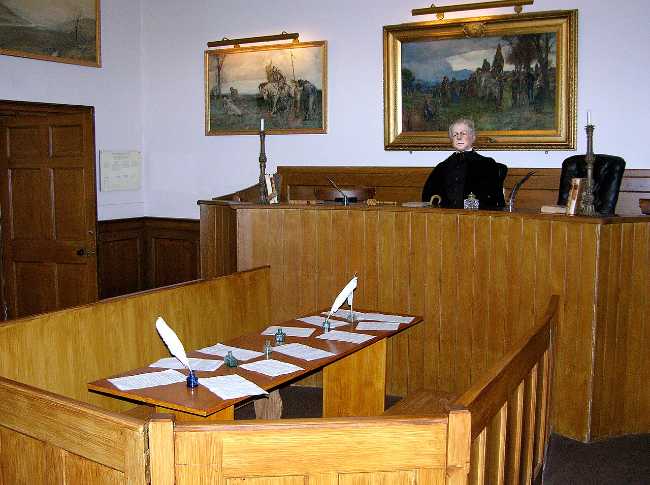
Sir Walter Scott’s Courtroom sits right in the heart of Selkirk, in the Scottish Borders. You’ll find it at Market Place, Selkirk, TD7 4BT, an imposing building from 1804 with a tall spire that dominates the town centre. This is where the famous writer served as Sheriff of Selkirkshire for nearly thirty years, and today it offers a reconstructed courtroom along with displays about his life and local history. Just outside stands a statue of Scott himself, known locally as the Shirra. A short stroll away is Halliwell’s House Museum, the oldest building in town, which explores Selkirk’s past with engaging local exhibits. A few miles west lies Bowhill House and its country estate, a grand mansion with art collections and grounds to wander. A little further on, near Melrose, is Abbotsford, Scott’s own home, filled with his books, armour and personal treasures. Melrose Abbey is also within easy reach, offering atmospheric ruins and more ties to the writer. The courtroom itself is free to visit in season and makes a fine starting point for exploring the Borders’ literary and historic sites.