Slawenburg Raddusch
Unlike the stone castles and palaces of Brandenburg, Slawenburg Raddusch offers a journey much further back in time. Located near the Spreewald, this remarkable site is a faithful reconstruction of a Slavic ring fort from the 9th and 10th centuries, built on the location of an original stronghold once used by the Lusizi tribe. It stands as one of the most unusual archaeological attractions in Brandenburg and provides a fascinating insight into the region’s early medieval past. The original fort was part of a network of dozens of Slavic refuge and storage forts that protected local communities during periods of conflict. Archaeological excavations carried out before nearby lignite mining uncovered the remains of the ancient fortification, allowing researchers to reconstruct it in impressive detail. The present-day structure was built between 1999 and 2003 and closely follows the dimensions and appearance of the original rampart. The most striking feature is the massive circular wall of wood, earth, and clay. Visitors can walk through the reconstructed gates and explore the impressive courtyard enclosed by the towering fortifications. The architecture vividly demonstrates how Slavic communities built and defended their settlements over 1,000 years ago.
Vetschau Germany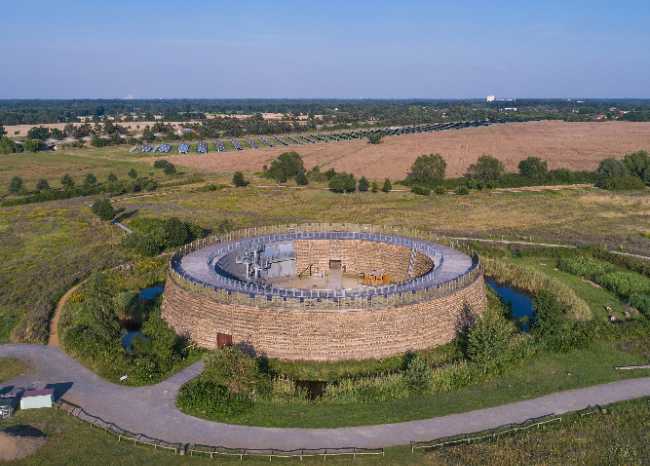
Slawenburg Raddusch sits just outside the little village of Raddusch, at Zur Slawenburg 1, 03226 Vetschau/Spreewald, in the Oberspreewald-Lausitz district in Brandenburg, Germany. It is in the heart of the Spreewald, about two kilometres on foot from Raddusch station, surrounded by meadows, canals, and quiet forest paths. You really feel like you have stepped back in time when you walk up to it. The Slawenburg is a faithful reconstruction of a Slavic ring castle from the 9th and 10th century, built between 1999 and 2003. It was made as an archaeological open-air museum about Slavic life, settlement, and building in Lower Lusatia, with its high wooden ramparts, gate, and houses inside. It is a lovely, easy place to wander around, take photos, and imagine how people lived here more than a thousand years ago. Nearby there is so much more Spreewald to enjoy. In Vetschau you will find Vetschau Castle and its park, and in Lübbenau you can visit Schloss Lübbenau, the Spreewald Museum, and the old town with its harbour for boat trips and canoe tours. A little further on are the open-air museum in Lehde, the Wendish-German double church in Vetschau, and the pretty villages of Burg and Lübben. It is perfect for a slow day out, a walk or a boat ride, and a bit of old Slavic history in between.