Auerbach Castle
Perched on a prominent hill above the town of Bensheim in the Odenwald, Auerbach Castle (Schloss Auerbach) is one of Hessen’s most impressive medieval castle ruins. Built in the 13th century by the Counts of Katzenelnbogen, the fortress overlooks the Bergstraße region and offers spectacular views across the Upper Rhine Plain. Its commanding position made it an important defensive stronghold and a symbol of noble power for centuries. One of the castle’s most fascinating features is its association with scientific history. In 1764, the famous astronomer and geodesist Johann Heinrich Lambert conducted experiments at the castle related to measuring the Earth's shape and distance calculations. This connection adds an unusual scientific dimension to a site better known for its medieval heritage. Today, visitors can explore extensive ruins that reveal the castle's former grandeur. Massive defensive walls, towers, gates, and remnants of residential buildings illustrate how a powerful fortress functioned during the Middle Ages. Walking through the grounds provides a vivid impression of the scale and strength of the original complex.
Bensheim Germany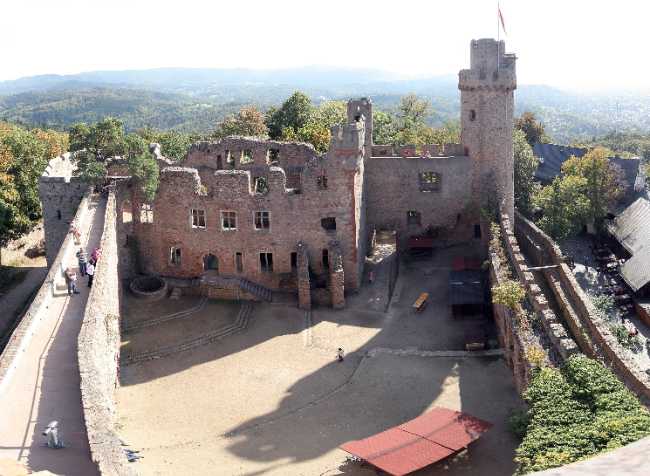
Auerbach Castle, or Schloss Auerbach, is one of the most imposing medieval fortress ruins in the Bergstraße region of Hessen. Location: Ausserhalb 2, 64625 Bensheim-Auerbach, Hessen, Germany. It is situated on a high wooded hill overlooking the town of Bensheim-Auerbach along the scenic Bergstraße. Because of its position along the warm and sunlit Bergstraße, visiting Auerbach Castle puts you right near charming historic towns, lush botanical gardens, and neighboring hilltop strongholds. Just down the hill lies the Staatspark Fürstenlager, a picturesque eighteenth-century landscape park filled with historic pavilions and exotic trees. A short drive away in Bensheim, you can wander through the historic old town to see traditional timber-framed buildings and the Museum Bensheim. Heading slightly north brings you to Seeheim-Jugenheim, home to Heiligenberg Palace and its surrounding parkland, while traveling south leads straight to Lorsch Abbey (Kloster Lorsch), a famous UNESCO World Heritage site known for its intact Carolingian gatehouse.