Imperial Palace of Gelnhausen
The Imperial Palace of Gelnhausen (Kaiserpfalz Gelnhausen) is one of the most remarkable medieval monuments in Hesse and among the finest surviving imperial palaces from the era of the Hohenstaufen dynasty. Built around 1170 by Emperor Frederick I, better known as Barbarossa, the palace served as an important residence for the rulers of the Holy Roman Empire and helped secure the major Via Regia trade route that crossed central Germany. What makes the palace especially fascinating is that, despite being partly ruined, much of its original Romanesque stonework remains intact. Historians consider it one of the best-preserved and most artistically valuable Staufen palaces in Germany. The complex was uniquely constructed as a moated palace on an island in the River Kinzig, giving it both strategic and symbolic importance. Visitors entering the palace can admire the impressive gatehouse, the massive rectangular keep, and the remains of the grand residential hall known as the palas. The highlight of the site is the extraordinary Romanesque architecture, including elegant arcaded windows, richly decorated capitals, carved stone columns, and detailed ornamental sculptures featuring animals, foliage, and human figures. These artistic elements demonstrate the craftsmanship of the 12th century at its finest.
Gelnhausen Germany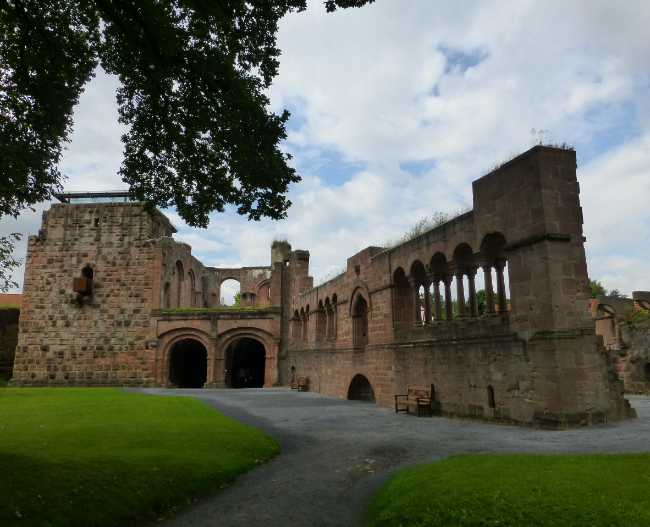
The Imperial Palace of Gelnhausen, or Kaiserpfalz Gelnhausen, is one of the best-preserved Romanesque palaces built by the Staufen dynasty. Founded in the 1170s by Emperor Frederick I Barbarossa, this moated castle complex was built on an island in the Kinzig River to guard important imperial trade routes. Location: Burgstraße 14, 63571 Gelnhausen, Hessen, Germany. It is situated on an island in the Kinzig River on the southeastern edge of Gelnhausen’s historic town center.Because of its position right near Gelnhausen's historic center, visiting the Imperial Palace places you within easy reach of preserved medieval architecture and regional heritage sites. A short walk into town brings you to the Romanesque Marienkirche church, the historic Market Square, and the Hexenturm tower. Also nearby is the Philipp Reis Museum, celebrating the inventor of an early telephone. A brief drive through the surrounding Main-Kinzig region leads to Ronneburg Castle (Burg Ronneburg) set high on a basalt hill, the historic Steinau Palace, and the Radio Museum in neighboring Linsengericht.