Keltenwelt am Glauberg
On a hill above the Wetterau, the Glauberg was one of Europe’s most important early Celtic centres. Around 500 BC it was a princely seat with ramparts, a reservoir and a sacred burial landscape. The star is the Celtic Prince of Glauberg: a 1.86-metre sandstone statue of a warrior, found almost intact, wearing a leaf-crown cap, torc and armour. It is one of the earliest life-size stone figures north of the Alps. Inside the striking steel museum, opened in 2011, you see the prince alongside his spectacular grave goods: a gold torc, weapons, a bronze jug that once held mead, jewellery and finely crafted vessels from rich 5th-century BC burials. Interactive displays explore Celtic power, faith, craft and daily life over 2,400 years ago. Outside, walk the 37-hectare archaeological park to the reconstructed burial mound, the 350-metre processional way flanked by ditches, ramparts and the Celtic World Trail. The mound and processional route were aligned to the landscape and sky, hinting at ritual and astronomy.
Glauburg Germany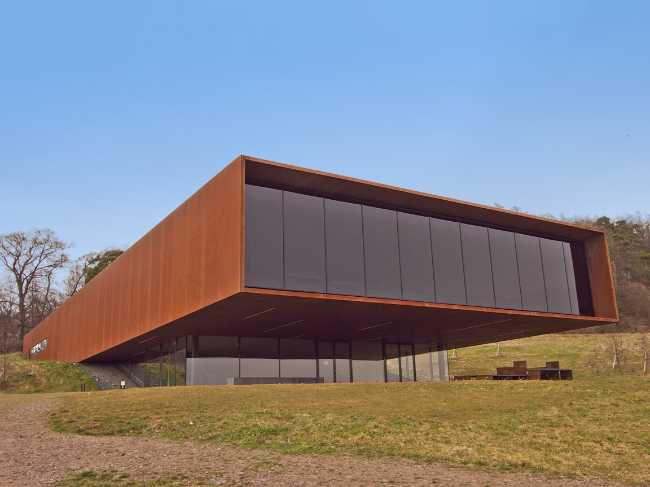
The Keltenwelt am Glauberg, or Celtic World at the Glauberg, is a striking modern archaeological museum and outdoor park set beside an ancient Celtic princely burial site in Hessen. Location: Am Glauberg 1, 63695 Glauburg, Hessen, Germany. It sits on the southwestern slope of the Glauberg hill in the Wetterau district, roughly thirty kilometers northeast of Frankfurt. Because of its position in the historic Wetterau region, visiting the Keltenwelt puts you within easy reach of charming medieval towns, grand fortresses, and local museums. Just a short drive east brings you to the historic half-timbered town of Büdingen, home to the impressive Büdingen Castle (Schloss Büdingen) and the Heuson-Museum. Heading south leads to the majestic hilltop fortress of Ronneburg Castle (Burg Ronneburg) and its castle museum. Other nearby highlights include the Art Casting Museum in Hirzenhain and the Vulkaneum interactive museum in Schotten.