Wiligrad Castle
Perched on a wooded bluff overlooking Lake Schwerin, Wiligrad Castle is one of the most picturesque historic residences in Mecklenburg-Western Pomerania. Built between 1896 and 1898 for Duke Johann Albrecht of Mecklenburg, the castle is a remarkable example of Neo-Renaissance architecture and was designed to reflect the grandeur of the region’s historic ducal traditions. Its name, “Wiligrad,” is derived from an old Slavic word meaning “great fortress,” linking the estate to the early history of Mecklenburg. The castle immediately impresses visitors with its striking red-brick-and-stone façade, decorative towers, elegant gables, and prominent dome. The architecture combines Renaissance-inspired details with the romantic character of a late 19th-century country residence, creating the appearance of a fairy-tale palace overlooking the lake. Inside, visitors can discover historic halls and representative rooms that once hosted members of the ducal family, distinguished guests, artists, and political figures. The grand stair hall is among the architectural highlights, showcasing the craftsmanship and attention to detail that characterized noble residences of the era. Exhibitions often focus on the castle’s history, architecture, and cultural significance, while parts of the estate are also used for contemporary art displays.
Lübstorf Germany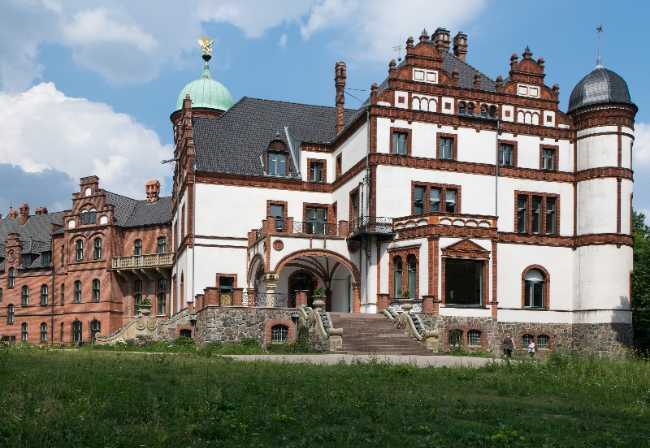
Wiligrad Castle, known locally as Schloss Wiligrad, is a striking red-brick historicist residence overlooking the forested western shore of Lake Schwerin. Location: Wiligrader Straße 17, 19069 Lübstorf, Mecklenburg-Western Pomerania, Germany. It sits nestled in the woods along the northern section of Lake Schwerin, roughly twelve kilometers north of Schwerin. Because of its scenic lakeside location between Schwerin and Wismar, visiting Wiligrad Castle puts you within easy reach of grand palaces, historic towns, and regional museums. A short drive south brings you to the state capital of Schwerin, home to the fairy-tale Schwerin Castle (Schloss Schwerin), the State Museum Schwerin, and the Open-Air Museum Schwerin-Mueß. Heading north leads to the UNESCO-listed Hanseatic city of Wismar, where you can explore the Schabbell Municipal Museum and the historic Wismar Princely Court (Fürstenhof).