Culross Palace
Culross Palace is one of Fife’s most evocative historic houses, a rare survival of 17th‑century domestic life. Built by Sir George Bruce, a wealthy merchant and industrial pioneer, the palace reflects the prosperity of a town once powered by coal mining, salt production and international trade. Its ochre‑washed walls and crow‑stepped gables make it instantly recognisable, but the real magic lies inside. The interiors are a time capsule of Scottish Renaissance taste. The High Hall impresses with painted timber ceilings, richly coloured friezes and carved furnishings that recreate the atmosphere of a prosperous burgh household. The Withdrawing Room offers a more intimate setting, with decorative panelling and period objects that hint at the Bruce family’s status and connections. Upstairs, the Long Gallery is one of the palace’s most striking features — a bright, elegant space used for exercise, conversation and display, unusually sophisticated for a Scottish home of its era. The King’s Room, traditionally linked to a visit by James VI, contains fine plasterwork and a sense of ceremony.
Culross Scotland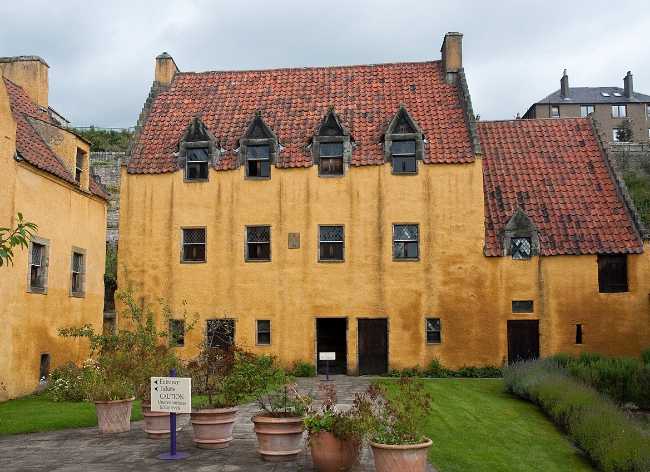
Culross Palace sits in the heart of the beautifully preserved village of Culross on the north shore of the Firth of Forth in Fife. The address is Culross, Fife, KY12 8JH. Right in the village itself you’ll find the ruins of Culross Abbey, a peaceful Cistercian site founded in the 1200s. A short drive takes you to Dunfermline Abbey and Palace, the burial place of several Scottish kings including Robert the Bruce. Across the water in West Lothian you can visit Linlithgow Palace, the birthplace of Mary Queen of Scots, and the striking Blackness Castle by the shore. Nearby too are the House of the Binns with its long family history, and Kinneil House with its museum. The whole village of Culross feels like a step back in time, with its cobbled streets and old merchant houses making a lovely place to wander after seeing the palace.