Eilean Donan Castle
Eilean Donan Castle, rising from a small tidal island at the meeting of three sea lochs, is one of the Highlands’ most photographed landmarks. Though the current structure dates to the early 20th‑century restoration by Lt. Col. John MacRae‑Gilstrap, the site’s history stretches back to the 13th century, when it served as a stronghold against Viking incursions. In 1719 it was destroyed during a Jacobite‑Spanish uprising, its ruins left exposed to the elements for nearly 200 years before the meticulous rebuild returned it to its romantic silhouette. Inside, the castle offers an intimate journey through clan heritage. The Banqueting Hall displays portraits, weapons, and MacRae family memorabilia, while the Drawing Room preserves early 1900s furnishings and views across Loch Duich. The Kitchen, reconstructed with period utensils and food displays, gives a sense of daily life before the castle’s destruction. Visitors can also see the Billeting Room, the Laird’s private quarters, and a small exhibition on the castle’s reconstruction, including original plans and photographs.
Dornie Scotland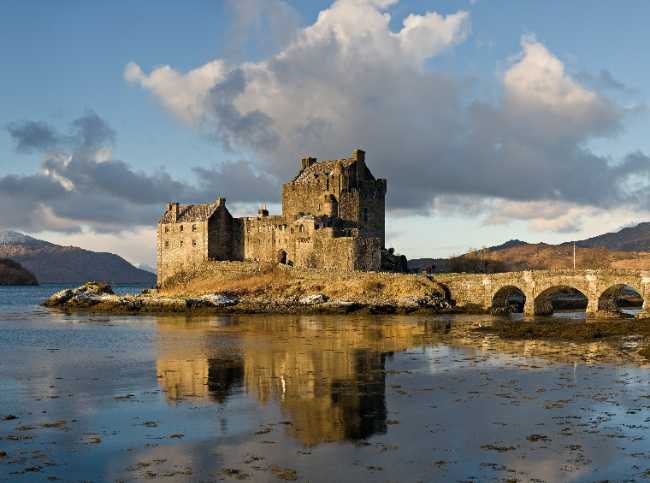
Eilean Donan Castle sits on a tiny tidal island where three sea lochs meet on the west coast of the Scottish Highlands, right beside the village of Dornie near Kyle of Lochalsh. The address is Dornie, Kyle of Lochalsh, IV40 8DX. You reach it by walking across a stone bridge from the mainland, and the setting alone makes it one of the most photographed spots in the country. The village of Dornie is just a short stroll away with a few places to eat and rest. A short drive west takes you over the bridge to the Isle of Skye, while nearby you’ll find the ruins of Strome Castle and the peaceful Balmacara Estate with its woodland garden. Further along the road are the ancient brochs of Glenelg, and the pretty harbour village of Plockton is not far either. It’s a perfect stop on the way to or from Skye, with dramatic lochs and hills all around.