Pennard Castle
Standing dramatically above the sweeping dunes of Three Cliffs Bay, Pennard Castle is one of the most picturesque and atmospheric ruins on the Gower Peninsula. Built in the early 12th century by the Normans, the castle was intended to control the surrounding area and defend against Welsh attacks. Its spectacular location offers some of the finest coastal views in Wales, making it a favourite destination for both history enthusiasts and photographers. One of the castle’s most fascinating stories is its battle against nature rather than invaders. During the 14th century, powerful winds carried vast quantities of sand inland from the nearby coast. The advancing dunes gradually overwhelmed the surrounding settlement, turning fertile land into sand-covered wasteland. As a result, Pennard became known as the “castle in the sand,” and the fortress was eventually abandoned. Today, visitors can explore the impressive remains of the stone curtain walls, towers and gatehouse. Inside the grounds, traces of domestic buildings and defensive structures reveal how the castle once functioned as a self-contained medieval stronghold. The surviving south tower is particularly striking, while sections of the walls provide excellent viewpoints across Three Cliffs Bay and the Bristol Channel.
Southgate Wales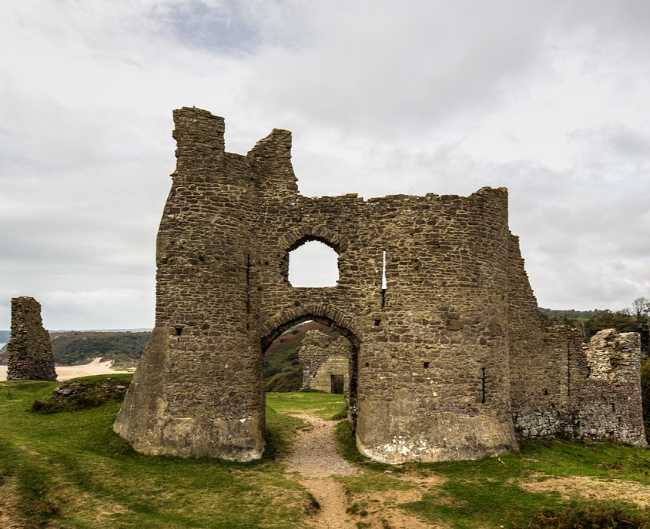
Pennard Castle is an atmospheric 12th-century ruined fortress dramatically perched on a limestone cliff overlooking the iconic sands of Three Cliffs Bay. Originally established as a timber ringwork by Henry de Beaumont, the first Earl of Warwick, the castle was later rebuilt in stone during the 13th and 14th centuries by the de Braose family. The castle is located at Pennard Road, Southgate, Pennard, Swansea, SA3 2EH, Wales, United Kingdom. It stands perched above Pennard Burrows and Three Cliffs Bay, accessed via a footpath across the local terrain near the village of Southgate. Because of its spectacular position on the southern coast of Gower, visiting Pennard Castle places you close to many notable historical and regional attractions. Just down the valley in Parkmill sits the Gower Heritage Centre, set around a working 12th-century watermill. A short drive west brings you to the Neolithic burial site at Parc le Breos Chambered Tomb and the grand Tudor ruins of Oxwich Castle. Heading east opens up access to the impressive coastal stronghold of Oystermouth Castle in Mumbles, while driving towards Swansea city centre leads to Swansea Castle, Swansea Museum, and the National Waterfront Museum.