Loughor Castle
Standing on a strategic hill overlooking the Loughor Estuary, Loughor Castle is a small but historically significant Norman fortress that played an important role in the medieval struggle for control of southwest Wales. Built shortly after the Norman conquest in the early 12th century, the castle guarded an important crossing point on the River Loughor, which marked a contested frontier between Norman-held territory and Welsh lands. Unlike many larger Welsh castles, Loughor Castle has a compact design, making it easy for visitors to explore. The most impressive surviving feature is the circular stone keep, built in the 13th century, whose thick walls still dominate the site. This tower replaced earlier timber fortifications and served as both a defensive stronghold and a symbol of Norman authority in the region. Inside the castle grounds, visitors can follow the outline of the curtain walls and earthwork defences that once protected the settlement. The remains of the gatehouse and internal buildings help illustrate how the castle functioned during its active years. Information panels explain the site's turbulent past, including periods when it was attacked, captured and rebuilt during conflicts between Welsh princes and Norman lords.
Loughor Wales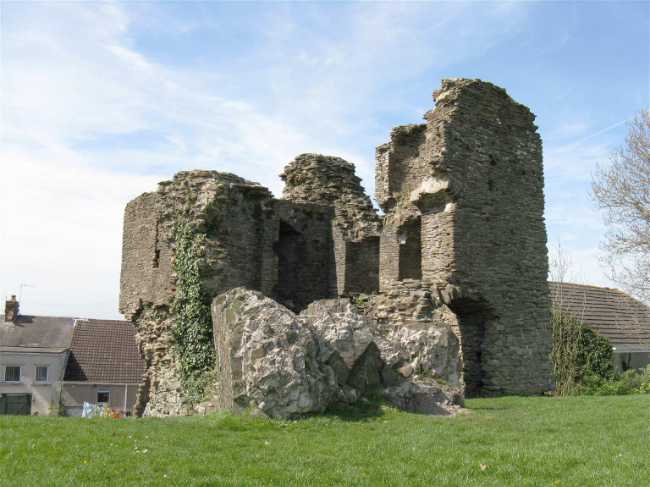
Loughor Castle is a fascinating medieval ruined fortress dramatically built inside the earthwork remains of a 1st-century Roman auxiliary fort known as Leucarum. Established around 1106 by the Anglo-Norman lord Henry de Beaumont, the castle served as a crucial border stronghold guarding the strategic crossing point over the River Loughor. The castle is located at Castle Street, Loughor, Swansea, SA4 6TK, Wales, United Kingdom. It stands situated on a raised mound overlooking the River Loughor on the northwestern boundary of the Swansea region. Because of its position near the mouth of the Loughor Estuary, visiting the castle puts you close to several historic and cultural regional attractions. Just a short drive south brings you onto the scenic Gower Peninsula, where you can explore the 14th-century fortified manor of Weobley Castle and the grand Tudor ruins of Oxwich Castle. Heading east into Llanelli leads to the historic Llanelly House and Parc Howard Museum and Art Gallery. Traveling further southeast toward Swansea city centre opens up access to Swansea Castle, the National Waterfront Museum, Swansea Museum, and the seaside fortress of Oystermouth Castle in Mumbles.