Duncansby Head Lighthouse
Standing at the north-easternmost point of mainland Britain, Duncansby Head Lighthouse is one of the most dramatic and rewarding coastal landmarks in Scotland. Located a short distance from John o’ Groats, the lighthouse overlooks the powerful waters of the Pentland Firth and the North Sea, where strong tides and unpredictable conditions have challenged mariners for centuries. Designed by David Alan Stevenson and first lit in 1924, it is one of the newer lighthouses built by the famous Stevenson family of lighthouse engineers. Unlike many traditional Scottish lighthouses, Duncansby Head features a distinctive square tower rather than the more familiar cylindrical design. Although the tower itself is only 11 metres high, it stands on cliffs around 67 metres above sea level, allowing its powerful light to be seen far out to sea. The lighthouse was automated in 1997 and continues to operate as an important navigational aid for vessels sailing through the busy waters between mainland Scotland and Orkney. The lighthouse is not open to the public, so visitors cannot explore the interior or lantern room. However, the surrounding landscape is the real attraction. Spectacular cliff-top paths lead to the famous Duncansby Stacks, towering sea pillars sculpted over thousands of years by wind and waves.
John o' Groats Scotland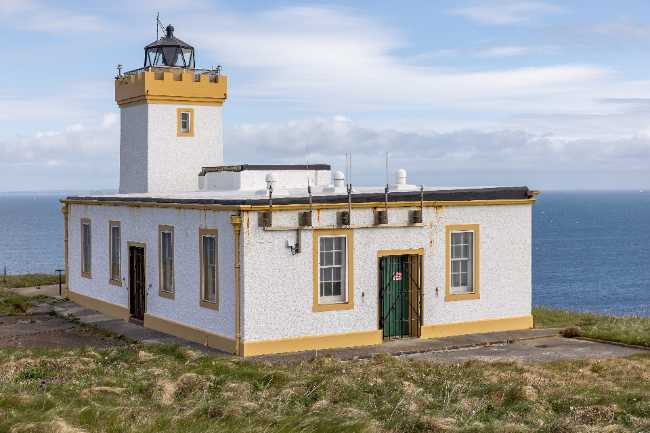
Duncansby Head Lighthouse is a distinctive square-towered beacon standing atop dramatic cliffs at the most northeasterly point of mainland Great Britain. Location: Duncansby Head, John o' Groats, Wick, KW1 4YS, Highland, Scotland, United Kingdom. It stands on the high headland cliffs at the far northeastern tip of Caithness, just two miles east of John o' Groats. Because of its prominent position along the Great British coastline, visiting Duncansby Head places you close to iconic Highland landmarks and historic sites. A short distance west brings you to the famous village of John o' Groats, where you can visit the iconic signpost and passenger ferry terminal for Orkney. Traveling further along the Caithness coast leads to the historic Castle of Mey, former royal home of the Queen Mother, the dramatic cliffside ruins of Castle Sinclair Girnigoe near Wick, the Wick Heritage Centre museum, and the nearby Dunnet Head Lighthouse sitting at mainland Britain's northernmost point.