Linderhof Palace
Hidden in a secluded valley of the Ammergau Alps, Linderhof Palace is the most intimate and elegant of King Ludwig II’s royal residences. Unlike Neuschwanstein and Herrenchiemsee, it was the only major palace that Ludwig lived to see completed, making it the most personal expression of his extravagant imagination and love of luxury. Inspired by the French royal court and especially Louis XIV, the palace is a masterpiece of Neo-Rococo design. Though relatively small on the outside, its interior dazzles visitors with gilded ornamentation, crystal chandeliers, elaborate wall paintings, and endless reflections created by magnificent mirrors. The famous Hall of Mirrors is one of the palace’s highlights, creating the illusion of a vast, sparkling palace stretching far beyond its actual size. The King’s Bedroom is the most lavish room in the palace, dominated by a monumental blue-and-gold canopied bed adorned with intricate embroidery, royal symbols, and rich decoration. Visitors can also admire the Audience Chamber, the Gobelin Salon, and the elegant Dining Room, which features Ludwig’s famous “wishing table.” This ingenious mechanism allowed meals to be raised from the kitchen below so the king could dine in complete solitude.
Ettal-Linderhof Germany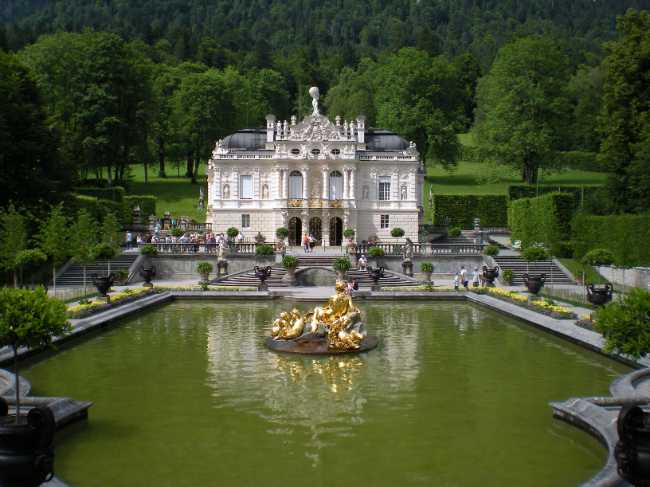
Linderhof Palace, or Schloss Linderhof, is the smallest of the three royal palaces built by King Ludwig II of Bavaria and the only one he lived to see completed. Location: Linderhof 12, 82488 Ettal, Bavaria, Germany. It is nestled deep in the secluded Graswang valley within the Ammergau Alps nature reserve near the Austrian border. Because of its scenic Alpine location, visiting Linderhof Palace places you close to a variety of historical, cultural, and spiritual landmarks across southern Bavaria. Just down the valley in Ettal stands the magnificent Benedictine Ettal Abbey, renowned for its grand Baroque basilica and monastic brewery. A short drive east leads to the picturesque village of Oberammergau, famous for its historic woodcarving heritage, colorful house frescoes, and the Passion Play theater. Heading further northeast brings you to the UNESCO-listed Wieskirche pilgrimage church. Taking the scenic mountain route westward brings visitors to the iconic twin fortresses of Neuschwanstein Castle and Hohenschwangau Castle near Füssen.