Church of the Dormition of the Virgin Mary
The Church of the Dormition of the Virgin Mary in Kalambaka is one of Thessaly’s most important Byzantine monuments, a three‑aisled basilica whose origins likely date to the 9th–10th century . Built on an artificial terrace beneath the Meteora rocks, it incorporates architectural traces of earlier phases, including a trivelon entrance, synthronon, and fragments of a mosaic floor preserved beneath the current flooring . Inside, the church offers a rare blend of artistic periods. The oldest frescoes—late 11th–early 12th century—survive in the southern aisle, while the majority of the painted decoration was created in 1573 by the priest Kyriazis and the Cretan monk Neofytos, son of the renowned painter Theophanes . The 18th‑century narthex frescoes add yet another historical layer. One of the church’s most remarkable features is its unique marble pulpit, the only one of its kind in Greece, reconstructed from early Christian architectural fragments and positioned in the center of the nave . Visitors can also see the marble ciborium, early Christian sculptural reliefs embedded in the southern wall, and a partially revealed mosaic floor near the left aisle . The interior preserves important inscriptions, including the golden bull of Emperor Andronikos III (1336) and the patriarchal sigillium of 1393, which defined and renewed the privileges of the Bishopric of Stagoi.
Kalambaka Greece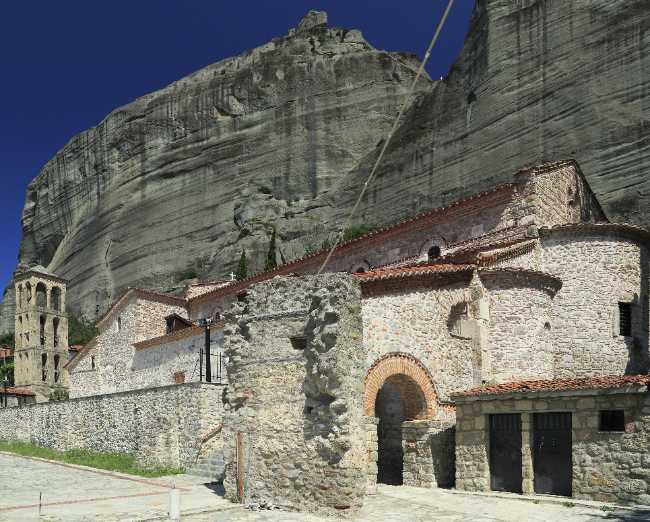
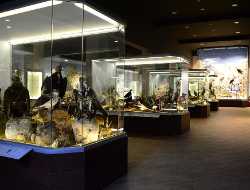
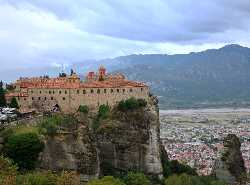
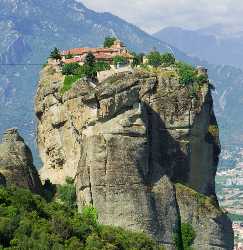
The Church of the Dormition of the Virgin Mary is an extraordinary ancient landmark nestled at the highest point of the old town of Kalambaka, Greece. Its official address is 22 Mitropoleos, Kalambaka 422 00. Originating as early as the 10th century on the foundations of an ancient temple, this historic Byzantine basilica is widely considered the oldest standing structure in the area and is famous for its stunning wall frescoes and rare free-standing marble pulpit. Positioned directly under the towering red rock pillars of Meteora, the church is ideally located for combining religious history with easy sightseeing. Just a short walk down into the main town brings you to the Museum of Natural History of Meteora and Mushroom Museum, as well as the Museum of Hellenic Culture. Strolling through the town center also lets you visit the Digital Projection Center of Meteora History and Culture to explore how the famous landscape was formed.If you head into the nearby village of Kastraki, you can check out the Geological Museum of Meteora. Towering right above the church are the majestic cliffside monasteries, with the Holy Monastery of St. Nicholas Anapausas and the Monastery of the Holy Trinity being among the closest to visit. A short distance south of town lies the prehistoric Theopetra Cave, giving you plenty of rich cultural and natural spots to discover around the immediate area.
 Museum
 Monastery
 Monastery