National Civil War Centre
Situated in Newark-on-Trent, the National Civil War Centre provides a compelling look into seventeenth-century Britain’s bloodiest conflict. Newark itself served as a vital Royalist stronghold for King Charles I, enduring three grueling sieges between 1643 and 1646 due to its key location along the River Trent and the Great North Road. The scale of this historical period is surprising. Proportionately, the British Civil Wars claimed more domestic lives than the First World War, wiping out roughly 3.5% of the population through fierce combat, severe famine, and devastating outbreaks of plague. During the town's final siege, trapped Royalists even minted their own emergency money inside Newark Castle. These distinct, diamond-shaped silver coins were crafted by melting down local household silver to pay soldiers on the front lines. Inside the museum, vibrant galleries bring this chaotic era to life. The World Turned Upside Down exhibit examines the radical political shifts of the time, featuring rare items linked directly to the trial and execution of King Charles I. Visitors can inspect an impressive collection of authentic arms and armor, from heavy pikeman breastplates to matchlock muskets and broadswords. Another stand-out display features the intricate wooden wheelchair used by Parliamentary General Sir Thomas Fairfax after he suffered debilitating battlefield wounds.
Newark-on-Trent United Kingdom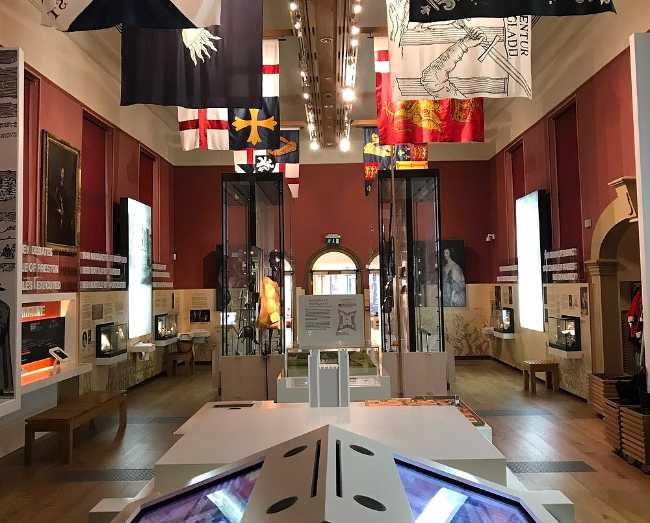
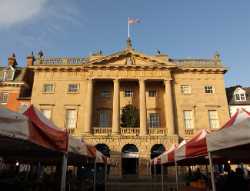
The National Civil War Centre sits right in the heart of Newark-on-Trent in Nottinghamshire, at 14 Appletongate, Newark, NG24 1JY. This quiet market town on the River Trent makes a natural base for anyone interested in the story of the English Civil Wars, and the centre itself is housed in a handsome old building that has stood here for centuries. Just a short stroll away you will find the ruins of Newark Castle, its weathered walls overlooking the river and the peaceful gardens that surround them. The parish church of St Mary Magdalene is almost next door, its tall spire still carrying a cannonball scar from the sieges. A little further on lies the Queen’s Sconce, one of the best-preserved Civil War earthworks in the country, set within the green space of Sconce and Devon Park. The lively market place is only a couple of minutes’ walk, full of independent shops and cafés, while the old Governor’s House stands nearby as another quiet reminder of the town’s wartime past. If you fancy a slightly longer outing, the graceful Southwell Minster and the remains of the Archbishop’s Palace are an easy drive away and add another layer of history to the day.
 Museum
 Museum