Arslanagić Bridge
Arslanagić Bridge is one of Trebinje’s most elegant historic landmarks, a 16th‑century Ottoman stone bridge that originally stood several kilometres upstream before being relocated in the 1970s to save it from flooding. Its graceful arches, built from finely cut limestone, were commissioned by the Arslanagić family—local nobles who managed the nearby caravanserai and controlled river trade routes. The bridge’s relocation is itself an engineering story: each stone was carefully numbered, transported, and reassembled, preserving its original proportions. Walking across it feels like stepping into a different century. The central arch is the tallest, designed to withstand the Trebišnjica’s seasonal surges, while the smaller side arches create a rhythmic silhouette reflected in the calm water below. Inside the structure—meaning within its architectural details—you can observe the traditional Ottoman construction technique: tightly fitted stones without mortar, relying on precision and weight for stability. The bridge also offers one of Trebinje’s most atmospheric viewpoints. From the top, you can see the river winding through poplar groves and the outlines of the old mills that once depended on its flow. At sunset, the arches glow in warm tones, making it a favourite spot for photographers and evening strolls.
Trebinje Bosnia and Herzegovina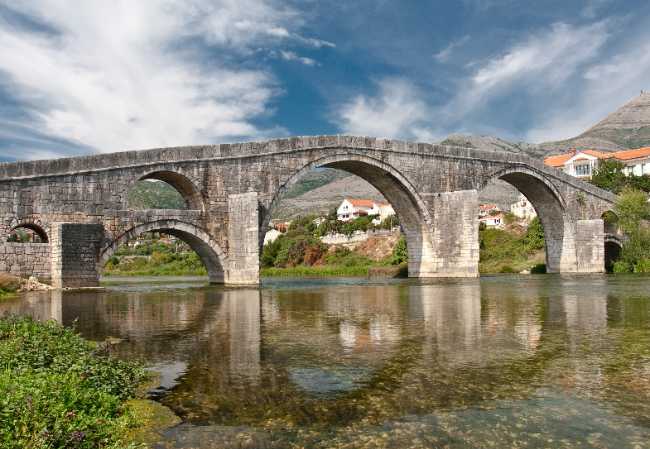
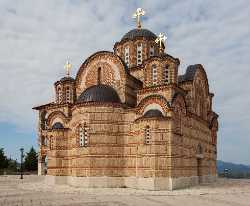
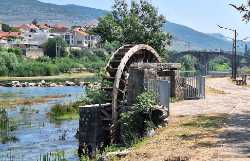
The bridge is located at Obala Mića Ljubibratića, Trebinje 89101, Bosnia and Herzegovina. It sits gracefully across the Trebišnjica River, connecting the Gradina and Police neighborhoods just north of the city center. Because the bridge spans the river close to the historic core, you can easily walk to all of Trebinje's major tourist attractions within fifteen minutes. A brief stroll along the riverbanks brings you to the Maltezovo Kolo watermill and into the stone streets of Trebinje's Old Town, where you can visit the Herzegovina Museum and the Emperor's Mosque. The town's vibrant central square, shaded by famous centuries-old plane trees, is just a short walk away. Looking up toward the surrounding heights, a quick drive leads directly to the magnificent Hercegovačka Gračanica monastery complex on Crkvina Hill, as well as historic military watchpoints like Kuchino Brdo Fortress and Strač Fortress.
 Museum
 Castle
 Fortress
 Church
 Tourist attraction