Catacombs Underground Church
The Catacombs of Jajce, often called the Underground Church, are among the town’s most unusual and atmospheric monuments. Carved directly into solid rock in the late 14th or early 15th century, they were commissioned by the powerful Hrvoje Vukčić Hrvatinić as a private family chapel and burial space. This makes them one of the rare subterranean sacral complexes in the Balkans, blending medieval Christian symbolism with an austere, cave‑like setting. Inside, visitors descend into a cool, dimly lit chamber where the stone walls still bear carved crosses, niches and symbolic motifs. The central hall, shaped like a small church with an altar and apse, is the most striking feature. One of the most interesting facts is the presence of a carved “sun and moon” motif above the entrance—an unusual detail that has inspired various interpretations, from medieval cosmology to heraldic symbolism. The burial chambers, cut with precise geometric lines, reveal the craftsmanship required to create such a space without natural light or modern tools. The acoustics inside are remarkable, giving the underground chapel an almost monastic stillness.
Jajce Bosnia and Herzegovina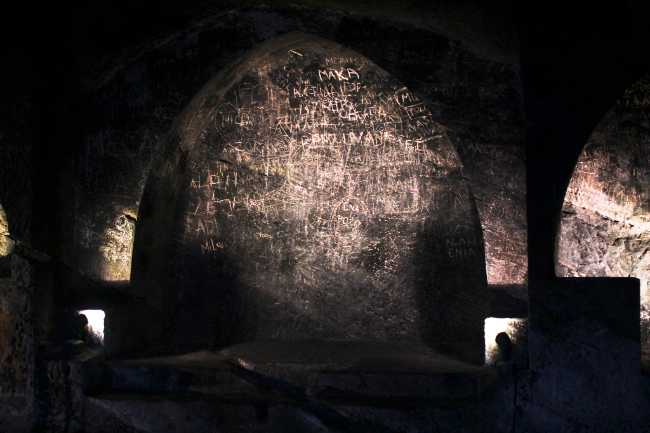
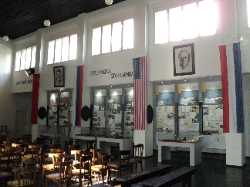
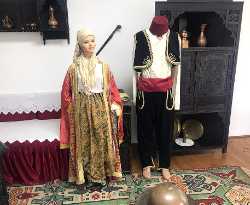
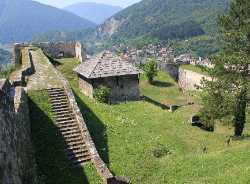
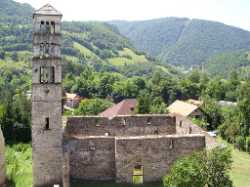
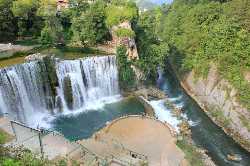
The crypt is located at Svetog Luke, Jajce 70101, Bosnia and Herzegovina. It sits nestled neatly inside the sloping hillside of the town's fortified historical core, tucked just below the main castle walls. Because the underground church is positioned right in the middle of Jajce's exceptionally compact old town, you can easily walk to all the town's famous historic landmarks within a few minutes. Walking just a short path uphill brings you straight to the massive gates of the Jajce Fortress, a grand medieval castle that overlooks the entire valley. Just a few steps outside the crypt entrance, you can check out the haunting stone ruins of Saint Mary's Church and its iconic Saint Luke's Bell Tower. Strolling just a couple of minutes further down the historic lanes leads you directly to the Ethnographic Museum, the beautiful Franciscan Monastery Museum, the world-famous Pliva Waterfall, and the historic Museum of the Second Session of AVNOJ.
 Museum
 Museum
 Museum
 Fortress
 Church
 Tourist attraction