Church of St. Nicholas Bolnički
Church of St. Nicholas Bolnički is one of Ohrid’s most intimate medieval churches, tucked into a quiet corner near the lake. Dating to the 14th century, it originally served as a hospital chapel—hence the name Bolnički, meaning “of the hospital.” This unusual function gives the church a distinct place in Ohrid’s religious landscape, reflecting the city’s long tradition of combining faith with care for the sick. Inside, the church preserves a remarkable set of frescoes painted by the celebrated Ohrid masters Michael and Eutychios, the same artists behind the Peribleptos Church. Their work here is smaller in scale but rich in detail, with expressive saints and finely modeled faces that show the transition toward the Palaiologan Renaissance style. The fresco of St. Nicholas himself is a highlight, notable for its warm colors and gentle realism. Visitors can also see fragments of older decorative layers, revealing how the church evolved over centuries of use. The compact interior, with its low vaults and soft light, creates a contemplative atmosphere that contrasts with Ohrid’s larger monuments. Outside, the simple stone façade and quiet courtyard offer a glimpse into the everyday rhythms of medieval life.
Ohrid North Macedonia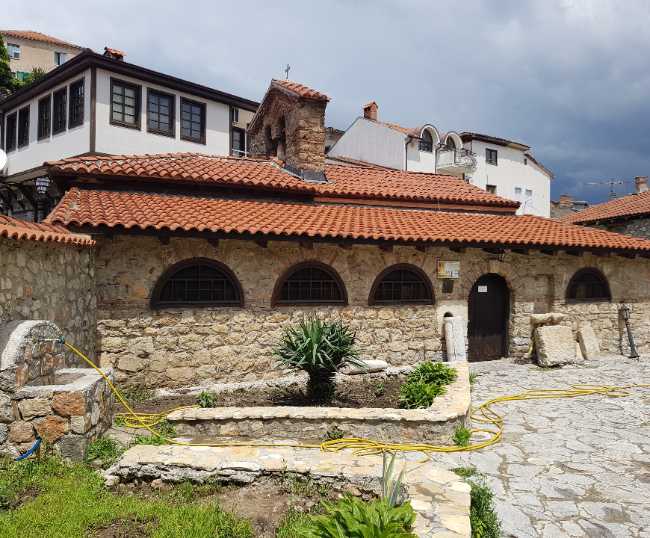
The Church of St. Nicholas Bolnichki is located in the lower part of the old town, near the Lower Gate entrance, at Car Samoil 33, Ohrid 6000, North Macedonia. The name Bolnichki comes from bolnica, meaning hospital, because this church and the one right opposite it used to serve as a quarantine and hospital during the Ottoman times. It is a very central location. Right across you have the Church of the Holy Mother of God Bolnichka, very similar and part of the same story. A minute away is the Lower Gate, one of the old city gates that still stands. From there you are just a short walk up Car Samoil street to the National Workshop for Handmade Paper, the Robevi Family House Museum, and the Church of Saint Sophia. If you keep going uphill you reach the Ancient Theatre of Ohrid, Samoil's Fortress on the hilltop, and the Church of Saints Clement and Panteleimon at Plaosnik. Going downhill you are straight in the main square and the lake promenade, with plenty of cafes and the old bazaar. It is all close, so you can easily see this little church as part of a relaxed walk through historic Ohrid.
 Museum
Icon Gallery of Ohrid
Museum
Icon Gallery of Ohrid
 Museum
Memorial House of Hristo Uzunov
Museum
Memorial House of Hristo Uzunov
 Museum
Memorial House of Grigor Prlichev
Museum
Memorial House of Grigor Prlichev
 Museum
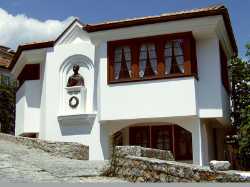
A. den Doolaard Museum
Museum
A. den Doolaard Museum
 Museum
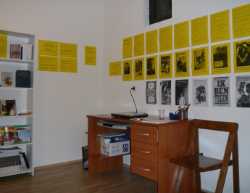
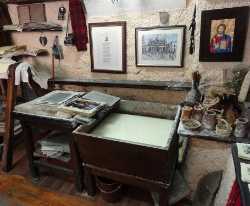
National Workshop for Handmade Paper
Museum
National Workshop for Handmade Paper
 Museum
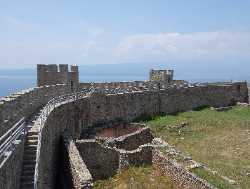
Samoil’s Fortress
Museum
Samoil’s Fortress
 Fortress
Church of Saint Sophia
Fortress
Church of Saint Sophia
 Church
 of Saint John the Theologian at Kaneo
Church
Church of Saint John the Theologian at Kaneo
 Church
 of Saints Clement and Panteleimon
Church
Church of Saints Clement and Panteleimon
 Church
 of the Virgin Mary Peribleptos
Church
Church of the Virgin Mary Peribleptos
 Church
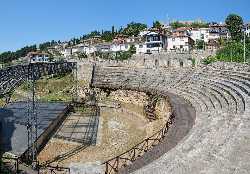
Ancient Theatre of Lychnidos
Church
Ancient Theatre of Lychnidos
 Theatre